


Parasitic infestations in the body are common in both children and adults.It occurs more often in children because they have poorer compliance with hygiene regulations and most parasites are transmitted fecal-orally.
Since the infestation is very diverse, the symptoms can vary greatly and are sometimes completely asymptomatic.For this reason, the diagnosis of parasites in the body sometimes requires a relatively large number of examinations necessary for the diagnosis.
Diagnostic basics
In order to recognize a parasitic infection, it is usually necessary to see a doctor.Since such a lesion usually does not cause much discomfort in both adults and children and causes non-specific symptoms, the patient often only realizes that he has an infestation when worms are detected in the stool.In the case of an infection with extraintestinal parasites (e.g. protozoa Giardia, amoeba) that are not excreted in the stool, the diagnosis is usually made by chance.
But even if helminths are detected in the stool, the patient must see a doctor and be tested for parasites.This is done not only to accurately identify parasites, but also to determine which species they belong to.
This is necessary in order to prescribe the most effective and least toxic drug to the rest of the body to treat the infection.Some medications only work on a specific type of pathogen.Unlike broad-spectrum drugs, they do not have such a pronounced negative effect on the human body.
For this reason, it is advisable to prescribe them when the causative agent of the invasion is accurately identified (for which you need to take tests for parasites in an adult or a child).In addition, a specialist can draw some conclusions when taking an anamnesis and identifying characteristic symptoms while talking to the patient.However, it is difficult to make an accurate diagnosis in this way (especially in adults due to the lower severity of symptoms).
For this reason, doctors recommend a blood test for parasites.And sometimes a stool analysis is enough.Your doctor will tell you where you can get tested for this indicator.This can be done in a municipal or commercial clinic, as well as directly in the laboratory.
There are also some special features when taking samples that a specialist will inform you about.And how much an infestation examination costs depends on where it is carried out and which samples need to be taken for diagnosis.
Stool analysis
When talking about what tests need to be done for parasites, the first thing that comes to mind for most patients is a stool test for parasites.Such diagnostics for the presence of helminths is actually prescribed primarily by doctors.
This is a simple study that is carried out in all medical institutions and laboratories of the corresponding profile.Testing for parasites is easiest and least traumatic this way.This is particularly important if a sample is taken from a child.There is no need to go to the laboratory and have blood drawn.
Patients independently test their stool for parasites.No special preparation is required.After a bowel movement, you must immediately put a small portion of the stool into a sterile tube and take it to the laboratory.
There is only one special condition: as little time as possible should pass between bowel movements and sample collection and delivery of the material to the laboratory.In addition, an examination for helminths of this type should be carried out in the morning.
The method is not universal.It helps to identify only the helminths and parasites that live in the colon.It is not suitable for identifying parasites that are located in other organs (e.g. in the liver), as well as helminths that are mainly found in the small intestine (pinworms), since these types of parasites with a certain life cycle do not enter the large intestine and do not leave the body with the stool.
However, many types of opportunistic extraintestinal invasions, for example with liver lesions, still occur in stool.They are simply present there in smaller quantities.The doctor will tell you based on the symptoms which test makes sense in each individual case.In fact, on this basis we can draw a conclusion about the probability of the presence of which parasites should be considered first.
Scrape
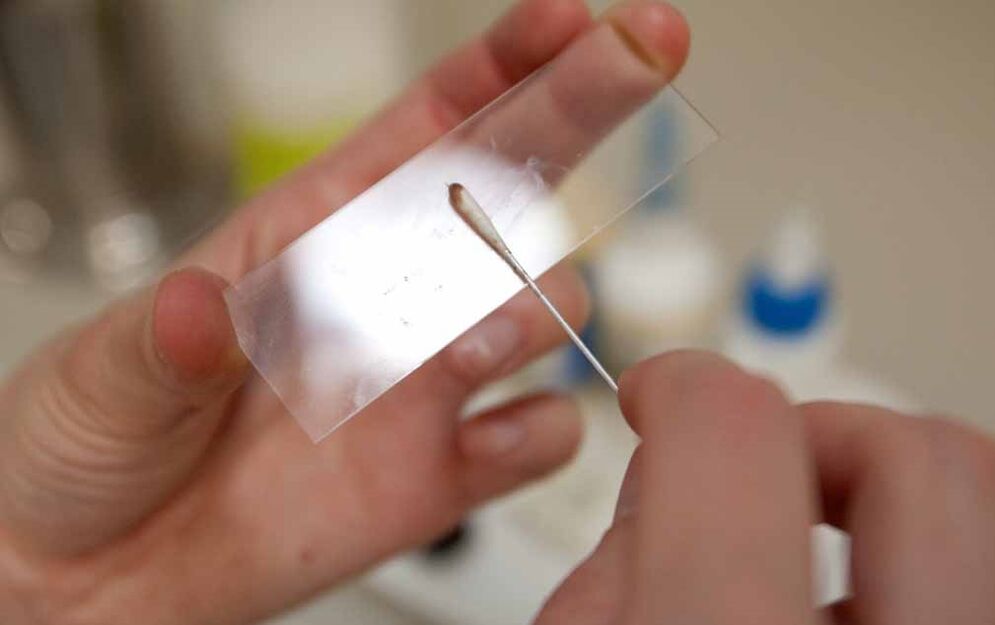
Another way to check for parasites yourself at home.This method is suitable for determining the presence of parasite species that come to the surface through the anus to lay eggs.
Most often, pinworms with this feature are found.To perform such tests, the anus must be scraped to test for parasites.
This requires a special test kit for enterobiasis.Some patients scratch with tape, but this method is not very effective.
The basic rules for sampling are as follows:
- This happens in the morning, immediately after waking up;
- You should not wash before conducting the study;
- It is recommended not to touch the anus before collecting the sample;
- Before taking a parasite test to the laboratory, you must store it in the refrigerator;
- There should be no more than 6-8 hours between the time of collection and the time of handover for research purposes.
Diagnosis of parasites in the human body using a test kit for enterobiasis is carried out as follows:
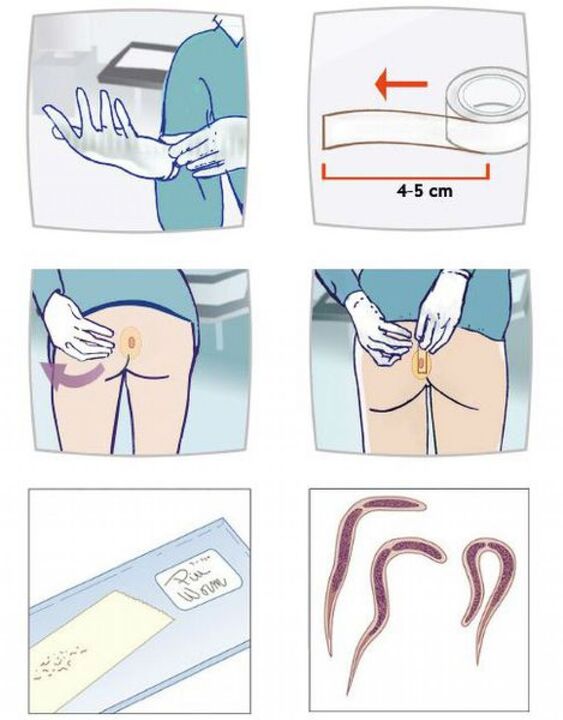
- Take the transparent polyacrylic spatula from the set;
- Apply some glue to the edge, which is also included in the kit;
- Place the spatula on the skin of the anal folds several times.
- Place the spatula in a sterile container, also included in the kit.
Take the container with the spatula to the laboratory.There are no difficulties in finding out where to get tested for parasites in Moscow.You can tour the laboratory.
In small towns, a referral from a parasitologist or infectious disease specialist is often required to submit the material to a clinical laboratory.
General blood test
Sometimes a general blood test for parasites in children and adults is required.It is able to indirectly confirm the presence of an invasion.If he confirms this, expensive and accurate blood tests for antibodies to parasites can be prescribed.UAC is cheap.
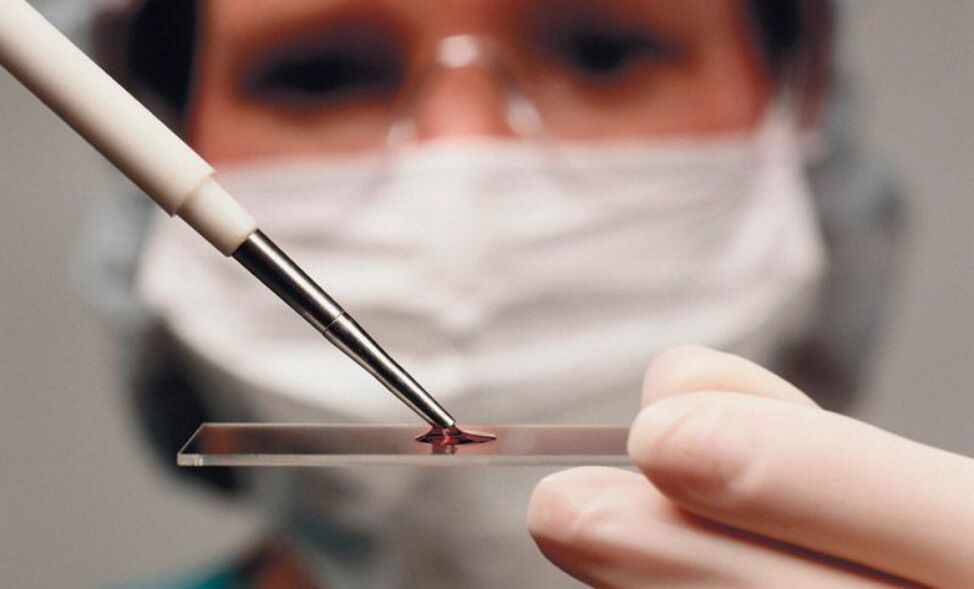
This type of study requires you to donate blood from your finger as it is done using a capillary sample.It is taken from the finger;In infants, there may be alternative collection sites: earlobe, heel, thigh.
You have to do a fasting test.Such a study will help determine:
- An increased content of eosinophils, eosinophilia, indicates an allergic reaction to parasites in the human body;
- An increased level of white blood cells indicates that the immune system is fighting intensively against something, possibly parasites (however, these indicators are also caused by viruses, infections and inflammatory processes);
- Reduced iron content during invasion can arise because parasites in the body do not allow useful substances to be absorbed into the blood in sufficient quantities, and also lead to constant microbleeds, as they injure the mucous membrane for nutrition.
A blood chemistry test is also sometimes recommended.A sample is taken from a vein and helps determine whether internal organs are functioning normally.Based on the results, it becomes indirectly clear which organ could be affected by the invasion, but it is prescribed quite rarely.The doctor takes over the decoding.
Enzyme immunoassay

An ELISA blood test for parasites is the most expensive and accurate test.This is the name of the analysis that shows the presence in the body of specific antibodies that the immune system begins to produce in response to an invasion.
An enzyme immunoassay blood test for parasites is good because it allows you to very accurately determine the type of parasite down to the strain.Antibodies are specific immunoglobulins that differ not only for different pathogens but also for different strains.As a result, such a study of the presence of parasites in the body allows not only an accurate diagnosis, but also the prescription of more “targeted” treatment.
This serological blood test for parasites is carried out using a sample from a vein.You can take it in the morning as it is important to take it on an empty stomach.Such an analysis to identify parasites takes several hours to days.The patient receives a detailed result from the laboratory showing the type of immunoglobulins (if any) and their quantity.
Deciphering a blood test for parasites is easy.Antibodies are present in large quantities when the infection develops.With some types of invasions, the body's immunity to them is formed;In this case, a small amount of immunoglobulins in the blood may indicate that the patient was previously infected but was cured.The absence of antibodies indicates that there is no infection or that it has occurred recently and the antibodies have not yet had time to develop.
You can donate blood against parasites yourself in this way, but due to the high cost, it is better to consult a doctor first.Therefore, it is sometimes pointless to donate blood using the ELISA method for the presence of parasites to people with immunodeficiency, HIV and lupus.